In today’s business world, communication is a key driver. Cloud PBX offers flexibility, scalability, and cost savings that traditional PBX systems cannot match. For service providers and resellers, understanding the different deployment models and architectures is crucial to offering solutions aligned with their clients’ varied needs.
Cloud PBX Deployment Models
Deployment models define where and how the system is hosted and managed, influencing operational complexity, scalability, and total cost. Two main options are presented: turnkey solutions and the Bring Your Own Infrastructure (BYOI) model.
Turnkey Solutions (Hosted by the Provider)
This model offers a system fully managed by the provider, ideal for resellers seeking a low-maintenance solution. It offers rapid deployment, seamless scalability, and minimal upfront cost, but limits customization and depends on the provider’s reliability.
Bring Your Own Infrastructure (BYOI)
BYOI allows providers to deploy Cloud PBX in their own infrastructure or cloud, offering full control over configuration, data security, and integration with existing systems. This model requires significant upfront investment and advanced technical skills.
Cloud PBX Architectures
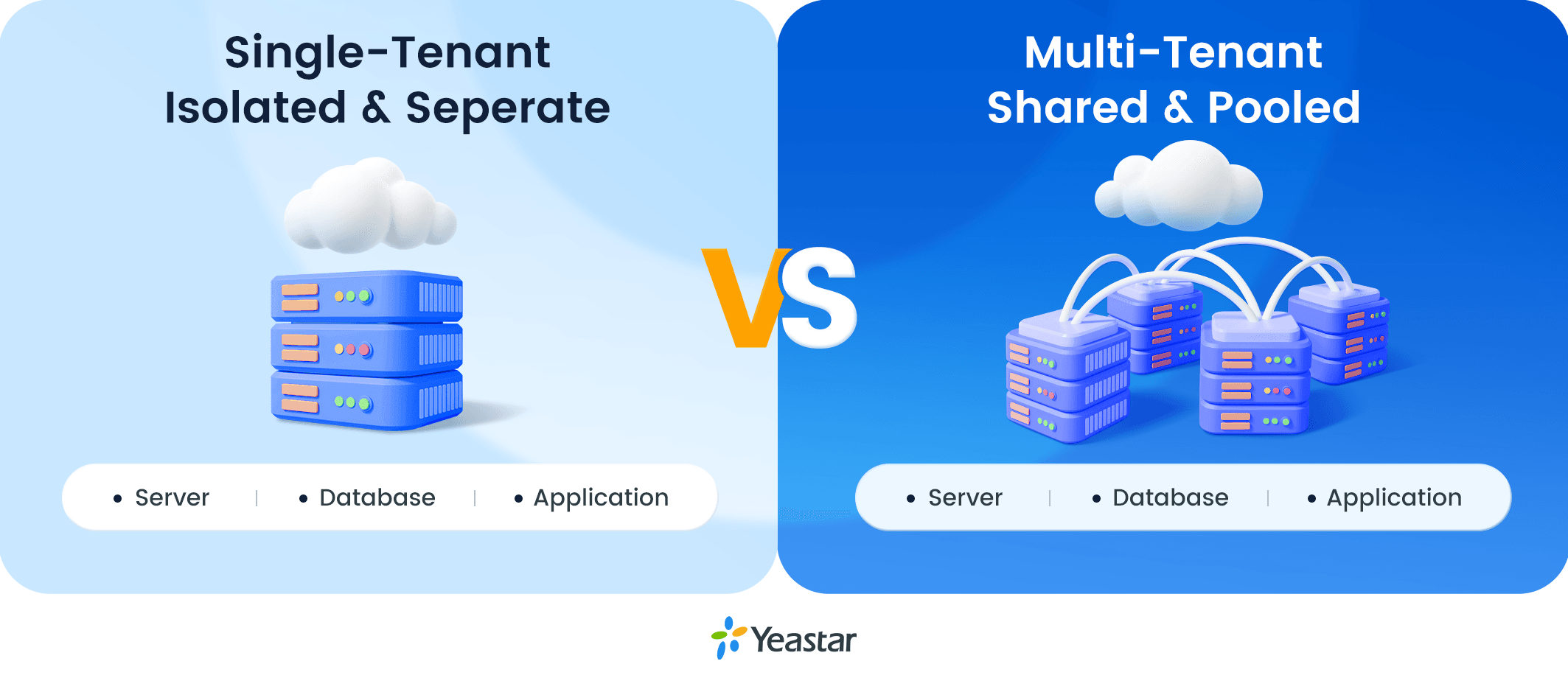
The architecture determines how resources are allocated and shared among users, affecting customization, security, and overall management. The two main architectures are single-tenant and multi-tenant.
Single-Tenant Architecture (Single‑Tenant)
Each client has a dedicated instance, ensuring maximum customization, enhanced security, and stable performance. This model is more costly and complex to manage, but suits businesses requiring complete isolation.
Multi-Tenant Architecture (Multi‑Tenant)
Several businesses share the same PBX instance while remaining isolated at the data level. It is cost-effective, scalable, and easy to maintain, but offers limited customization and relies on robust security protocols.
Multi-Instance vs Multi-Tenant
Multi-instance combines each client’s independence with the shared use of a common infrastructure. Each client has its own PBX instance, enabling greater customization while retaining the benefits of scalability.
Key Benefits of Multi-Instance
Instance isolation, advanced customization, rapid scalability, and resource efficiency. This approach is ideal for resellers seeking to offer each client a distinct experience without sacrificing cost efficiency.
How to choose the right solution for your business
The choice depends on your budget, need for control, IT resources, and growth plans. Turnkey solutions work best with an OpEx model, while BYOI aligns with a CapEx model. Single-tenant architecture is more expensive but offers more control, whereas multi-tenant is cost-effective but less flexible.
Control and Customization
If you need extensive customization and full control over data, BYOI with a single-tenant architecture is recommended. For a standardized, less demanding approach, the turnkey or multi-tenant model may suffice.
Available IT Resources
Businesses with strong IT skills can opt for BYOI, while those with limited resources will benefit from a turnkey solution managed by the provider.
Growth Plans and Scalability
Turnkey solutions offer smooth scalability, ideal for fast-growing or seasonal businesses. BYOI also enables scalability, but requires additional resources for expansion.
The Yeastar team supports businesses and integrators in assessing their needs, selecting an architecture, and preparing for deployment.