Businesses comparing 3CX and FreePBX face two very different approaches to a modern PBX system. While 3CX offers a ready-to-use solution with an intuitive interface, FreePBX provides complete flexibility through its open-source core based on Asterisk. The choice will depend on your deployment, customization, collaboration, and administrative resource needs. This guide introduces both platforms, their major differences, and helps you determine which best suits your context.
What is 3CX?
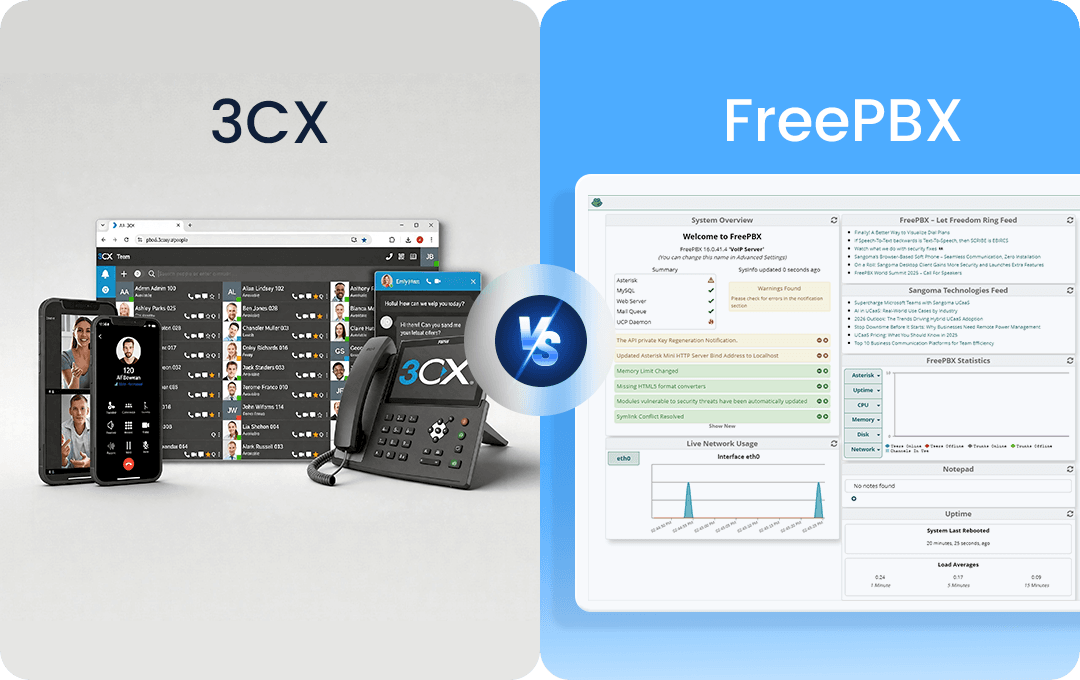
3CX is a commercial IP PBX platform that brings calls, collaboration, and customer communication together in one system. It includes voice, mobile and web apps, live chat, video conferencing, and support for multiple deployment options (cloud, on-premises, or self-hosted).
What is FreePBX?
FreePBX is an open-source IP PBX solution developed on the Asterisk telephony engine and maintained by Sangoma Technologies. It offers complete control over the configuration, deployment, and ongoing management of your business phone system.
Key differences between 3CX and FreePBX
3CX stands out for its quick installation, streamlined interface, and centralized management, but limits advanced customization. FreePBX, by contrast, enables extensive customization through its modular architecture, although administration is more demanding and requires technical expertise.
Installation and administration
3CX offers guided deployment and a flat annual license, simplifying implementation. FreePBX provides an intuitive graphical interface, but administration remains more complex, especially when combining modules, securing the environment, and ensuring maintenance.
Customization and flexibility
FreePBX excels in customization: choice of modules, call-plan logic, and compatibility with various SIP endpoints and telephony hardware. 3CX is more controlled, which can be an advantage for organizations seeking a standardized configuration.
Voice, collaboration, and mobility features
Both platforms support voice, but 3CX natively integrates mobile apps, video conferencing, screen sharing, and messaging via WhatsApp or Facebook. FreePBX can be extended to support these features, but they are not included by default.
Integrations
3CX offers native CRM integrations (Zendesk, Zoho, Salesforce, Freshdesk) and connections to Microsoft 365, Google Workspace, or Teams. FreePBX offers modular add-ons such as CRM Link to connect the PBX to CRM systems, but the experience remains more fragmented.
Pricing and total cost of ownership
3CX uses a flat annual licensing model, but has undergone several pricing policy changes. FreePBX is free at its core, but actual costs include hardware, implementation, paid support, and additional modules. The choice depends on administrative capacity and your team's structure.
Security, support, and maintenance
3CX offers backup, monitoring, and automatic recovery tools, but has experienced security incidents and forced updates. FreePBX provides community documentation and security guidance, but requires the operator to manage security proactively.
Which solution should you choose?
The choice between 3CX and FreePBX comes down to the flexibility required, administrative capacity, and preference for an integrated communication experience or complete control. A third alternative, Yeastar, sits between these two extremes, offering a guided and customizable solution.
The Yeastar team supports businesses and integrators in assessing their needs, selecting an architecture, and preparing for deployment.