Automated calling systems have evolved from traditional IVR to AI voice agents. Contrary to the idea that AI would replace IVR, the reality is that each technology excels in specific contexts. This article compares their features, identifies situations where one or the other is preferable, and explains how to combine them effectively.
Technology definitions
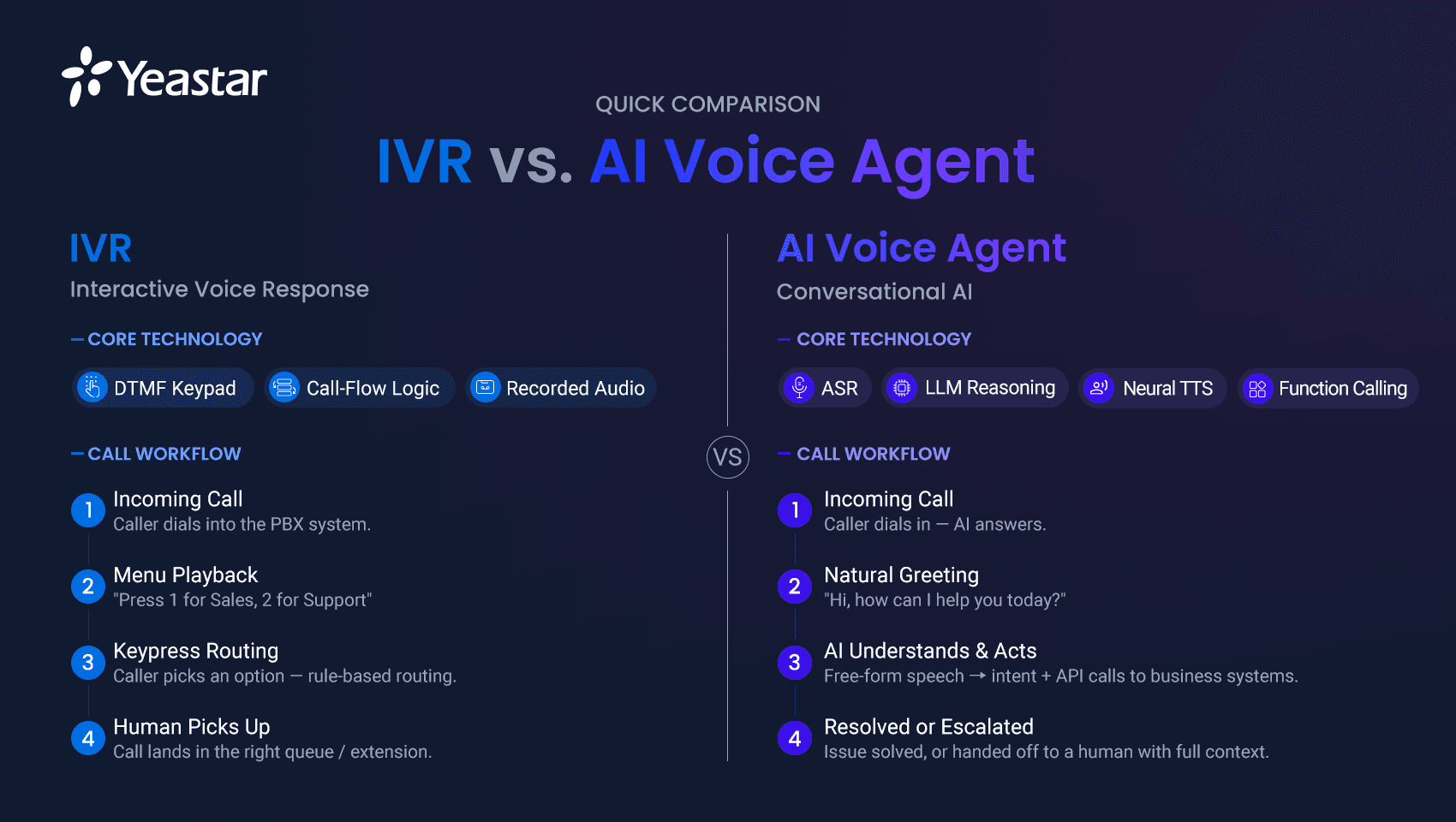
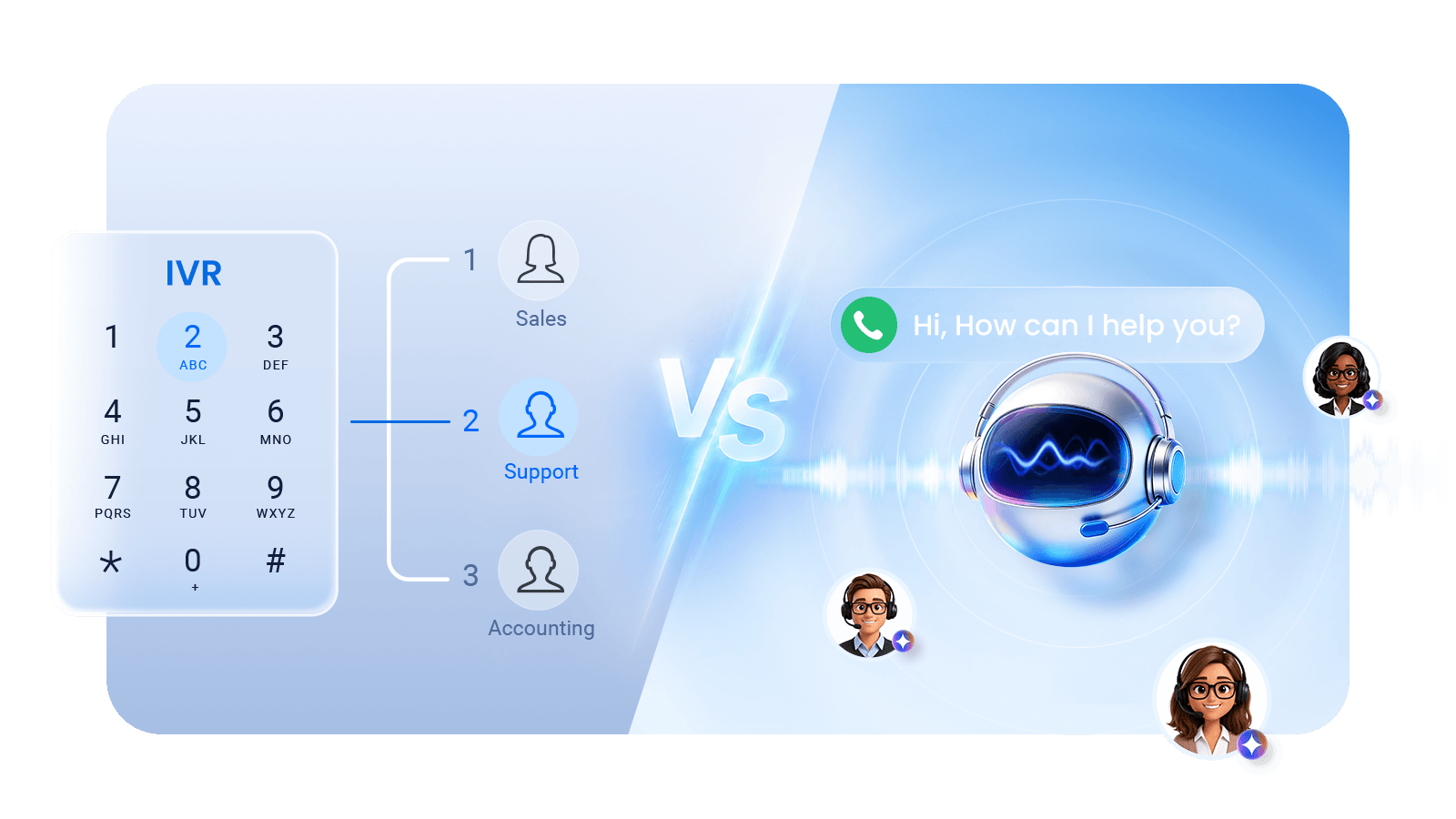
IVR (Interactive Voice Response) is an automated calling module that plays prerecorded messages and collects responses via the keypad or limited speech recognition to route the call to an extension or queue. An AI voice agent, on the other hand, relies on advanced speech recognition, a language model, and neural speech synthesis to understand free-form speech, maintain contextual memory, and perform actions via API calls.
Side-by-side comparison
IVR follows predefined rules, offering predictability and near-zero marginal cost, while an AI voice agent interacts according to context, with costs tied to LLM inference. IVR is integrated into most PBXs, whereas an AI voice agent requires model and system integration.
When IVR remains relevant
IVR is ideal for precise routing at scale, regulated processes that require audibly identical paths, and small businesses with limited decision flows. Its predictability, limited scope, and low cost make it the preferred choice in these scenarios.
The strengths of an AI voice agent
With natural language understanding, contextual memory, flexible integration with business systems, and multilingual support, an AI voice agent handles complex conversations, resolves tasks directly in the call, and adapts to callers’ multiple requests.
Combining IVR and an AI voice agent
Businesses often benefit from a hybrid approach: IVR for screening and structured routing during business hours, and an AI voice agent for autonomous handling after hours or for complex requests. This combination covers the entire customer journey without sacrificing accuracy or flexibility.
Yeastar P‑Series Solution
The P‑Series PBX system natively integrates IVR and the AI voice agent (AI Receptionist) with no additional code. It offers multi-level menus, time-based routing, and multilingual support for 34 languages, as well as in-call actions via custom tools or the MCP server.